

Overview
Trading fees are the costs you pay when you buy, sell, or trade on an exchange. On Orderly, fees are measured in basis points (1 bps = 0.01%) of your trade’s total value. Orderly Network uses a two-layer fee structure:- Base fees: The cost the Builder (the DEX) pays to Orderly Network.
- User fees: The fee the Trader pays to the Builder.
The dual-layer example
Here’s how the two layers work together in practice:- Orderly base taker fee: 3 bps (0.03%)
- Builder custom fee: 5 bps (0.05%)
- Result: The Trader pays 5 bps. Orderly retains 3 bps, and the Builder keeps 2 bps as profit.
Fee types
Maker fees: Charged when your order adds liquidity to the order book — for example, a limit order that doesn’t fill right away. Maker fees can be negative (rebates) for higher tiers, meaning you receive a rebate when your order adds liquidity. Taker fees: Charged when your order removes liquidity by filling immediately — for example, a market order. Hidden order fills: When hidden quantity from a resting limit order is matched by a new incoming order, the hidden side is marked as Taker and charged the taker fee. If the incoming order is eligible to be maker, such as a Post Only order that matches only hidden quantity, the incoming order is marked as Maker and charged the maker fee. Liquidation fees: If your position gets liquidated, a liquidation fee is applied. See the liquidation fee docs for details.Perpetual futures trading fees are charged after every trade in USDC and are factored into the
position’s average entry price.
How fees work for Traders
As a Trader, you pay a single fee per trade that’s set by the Builder (the DEX you’re using).- Total fee paid: You see one transparent fee per trade. This fee typically includes Orderly’s base fee plus the Builder’s margin.
- How it’s charged: Fees are automatically deducted from your USDC balance when your trade executes.
- Maker vs Taker: Whether you pay the maker or taker rate depends on how your order is filled. If your order sits in the book and waits, you’re a Maker. If it fills immediately, you’re a Taker.
How fees work for Builders
Orderly gives Builders full control over their pricing. You set your own trading fees while tapping into Orderly’s shared liquidity.- Set your own fees: You decide what to charge your users. The only rule: your fee must be at least as high as Orderly’s base fee. The base fee is set per product type, so Orderly Predict has its own base fee; see Orderly Predict fees.
- Keep your fee margin: For taker fees, you retain 100% of the margin between what you charge users and what Orderly charges you. For maker fees, positive fees collected from traders are Builder revenue. Protocol-funded maker rebates are passed through to traders and are not Builder revenue.
- Base fee tiers: The base fee Orderly charges you depends on your tier in the Builder Staking programme.
Builder Staking programme
Builders can get lower base fees and better support by hitting monthly volume targets or staking $ORDER tokens. If you qualify for different tiers through both volume and staking, you automatically get the higher tier (lower fee). Builders are entitled to the same Orderly base fees regardless of whether trades are on crypto or RWA markets. Builders can still configure different user-facing trading fees for crypto and RWA trades respectively. Orderly Predict uses its own base fee schedule, shown as the “Predict taker base rate” row below; see Orderly Predict fees for how that number is used.- Overview
- Public
- Silver
- Gold
- Platinum
- Diamond
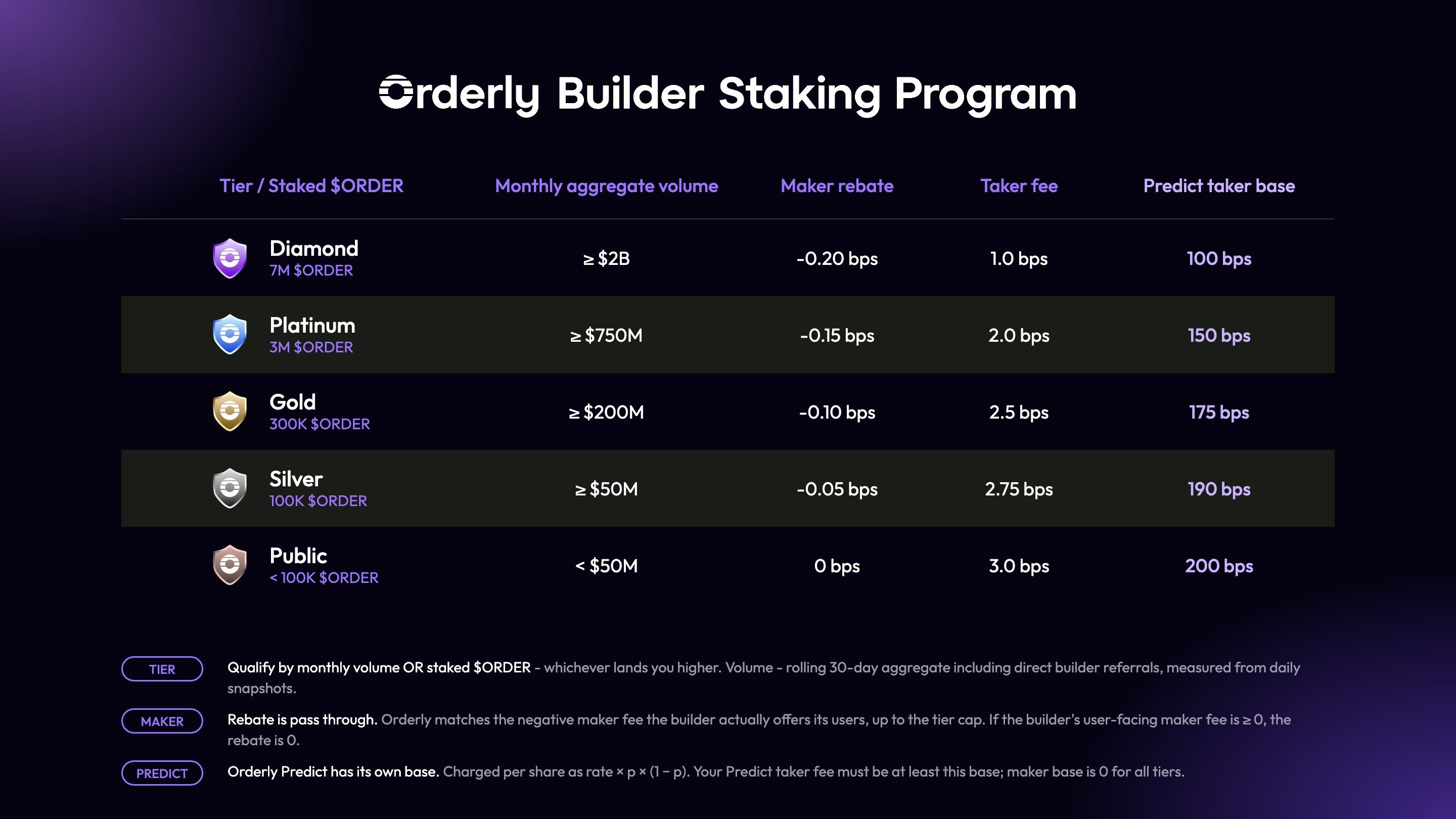
Fee tier notes:
- Volume calculation: 30-day aggregate trading volume includes all activity from the Builder and their direct Builder referrals, calculated from daily snapshots to determine tier eligibility.
- Minimum tier assignments: Minimum tiers may come from the distributor program or internal strategic assignments. They act as a floor, but builders can still move to higher tiers through staking or volume at the next daily refresh.
- Conditional maker rebates: The negative maker rate for Silver tier and above is a cap on the rebate Orderly will fund when the Builder passes a negative maker fee through to the trader. Orderly funds no rebate when the trader’s maker fee is zero or positive. The funded rebate belongs to the trader and is not Builder revenue. See Conditional Maker Rebates for examples.
- Predict base rate: This number is not a flat bps rate. It is the coefficient
basein the Predict fee formulashares x p x base x (1 - p)(see Orderly Predict fees), so it cannot be read next to the “Base taker fee” row above as a directly comparable rate. Predict maker base rate is 0 bps at every tier.
Orderly Predict fees
For what Orderly Predict is and how a round works, see the Orderly Predict Overview. Orderly Predict uses a different fee formula from perpetual futures and RWA markets, because the formula weights the traded pricep (0.01 to 0.99) with a p x (1 - p) term rather than charging a flat rate. This section covers how the fee is calculated and how it splits between Orderly and the Builder.
How the fee is calculated
Orderly Predict trades UP and DOWN shares. Every fill is priced and charged on its UP-book execution price, even for a DOWN trade:pis the UP-book execution price for that fill. A DOWN trade at pricedis the same fill at UP pricep = 1 - d; the formula always usesp, never a separate DOWN formula.fee rateis the account’s Predict maker or taker rate, chosen by the role — maker or taker — of that fill. Which rate applies to you depends on the app you’re trading on — check your app’s order screen to see your current rate. Unless the Builder you’re trading through has customized it, the default is taker 300 bps, maker 0 bps.- Fees are charged in USDC and calculated fill by fill. An order that fills across several prices is never charged on its average price.
Builders integrating via API can read an account’s current rates from
binary_maker_fee_rate and
binary_taker_fee_rate on GET /v1/client/info
(bps, divide by 10000 to get the decimal rate used in the formula below).p x (1 - p) term, the fee is not a flat percentage of the fee rate:
- At
p = 0.50, the fee per share is 25% of the fee rate — the highest point on the curve. - At
p = 0.10orp = 0.90, the fee per share is 9% of the fee rate. - Expressed against the traded notional (shares filled x
p), the effective rate isfee rate x (1 - p): it is highest whenpis low and lowest whenpis high, even though the fee amount itself is largest atp = 0.50.
Worked example (default taker rate, 300 bps)
Buying 100 shares atp = 0.50:
- Fee per share:
0.50 x 0.03 x 0.50 = 0.0075 - Fee for the fill:
100 x 0.0075 = 0.75USDC - Trade notional:
100 x 0.50 = 50USDC, so the fee is 1.5% of notional
p = 0.10:
- Fee per share:
0.10 x 0.03 x 0.90 = 0.0027 - Fee for the fill:
100 x 0.0027 = 0.27USDC - Trade notional:
100 x 0.10 = 10USDC, so the fee is 2.7% of notional
Maker and taker rates
- Default user rates are taker 300 bps, maker 0 bps. Builders can adjust maker up from 0 bps, and can only adjust taker down, since the default taker rate already sits at the shared cap. Taker cannot go below the tier’s Predict taker base rate; see Custom Fee Structure for how.
- The Predict maker rate has a floor of 0 bps, and the Predict taker rate has a floor of the tier’s Predict taker base rate. Unlike perpetual futures and RWA, Predict does not support negative rates or maker rebates.
- Predict maker and taker rates share the same upper cap of 300 bps (0.03), inclusive. A Builder-set value above the cap is rejected when written.
- A maker rate of 0 bps is a valid configuration and means makers are charged exactly no fee.
- Settlement at expiry is performed by the system, not by matching, and is never charged a fee. Only trades — opening a position or exiting it early with an opposite trade — are charged.
Predict base rate
Every Predict fill splits between Orderly’s base fee and the Builder, using the samep x (1 - p) curve as the user-facing fee:
- The base rate depends on the Builder’s Builder Staking programme tier, using the same tier rules as other markets. See the “Predict taker base rate” row in each tier above.
- Predict maker base rate is 0 bps at every tier.
- Predict trading volume counts toward the Builder’s 30-day aggregate volume tier threshold together with perpetual futures volume, counted as shares filled x the UP-book price
p(the fill’s notional) — even for a DOWN fill — not raw share count. - Builders cannot set a Predict taker rate below the tier’s Predict taker base rate, the same rule as other product types.
- If a Builder’s tier drops and its Predict taker base rate rises, any existing Predict taker rate below the new base rate is raised to the new base rate automatically.
- Because the user-facing rate is always at least the base rate, the split between Orderly and the Builder is constant at every price
p.